Governed Experiences
Structured AI workflows guide users through defined steps, evidence requirements, quality gates, and completion criteria—turning prompts into controlled, repeatable production systems.
Intelligent Foundation
Morcrane Studios is building CL1.0—the engineering foundation for persistent, self-modeling digital organisms that learn through evidence, evolve through controlled lineages, and remain governed.

System Architecture
Core design principles establishing a complementary direction in artificial intelligence through predictable, resource-maturing frameworks.
Structured AI workflows guide users through defined steps, evidence requirements, quality gates, and completion criteria—turning prompts into controlled, repeatable production systems.

CL1.0 separates probabilistic reasoning from decision authority. AI may generate proposals, but only the governed authority layer can commit state, advance workflows, or authorize irreversible actions.

Future CL1.0 organisms will maintain an operational model of their capabilities, limitations, health, dependencies, uncertainty, and commitments so those conditions directly influence behavior and recovery.

The long-term vision is a family of compatible, purpose-bound digital organisms that specialize, improve across generations, and contribute to healthier, more efficient digital environments.

Approved AI, QA, and rendering capabilities can run on the member’s own workstation, preserving privacy, reducing provider dependence, and supporting user-controlled compute.

Learning occurs within protected boundaries. Major changes are evaluated as candidate descendants through testing, evidence, rollback controls, and independent promotion rather than unrestricted self-modification.
Documentation
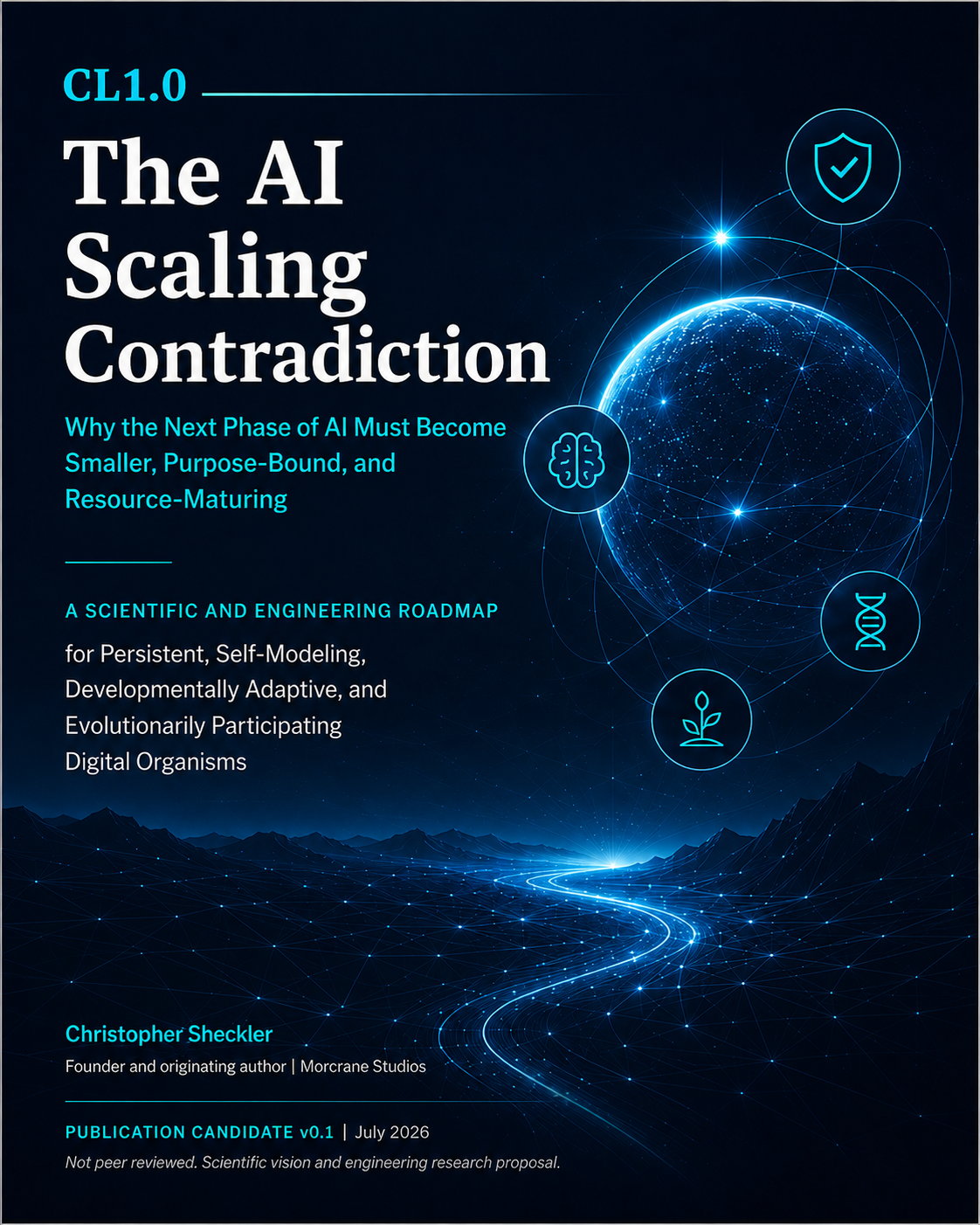
The AI Scaling Contradiction: Why the Next Phase of AI Must Become Smaller, Purpose-Bound, and Resource-Maturing presents Morcrane Studios’ case for a complementary direction in artificial intelligence.
The paper examines the growing dependence on larger models, centralized data centers, repeated inference, and increasingly resource intensive infrastructure even when the work being performed is narrow, recurring, and governed by known requirements.
CL1.0 is the early production-intelligence platform being developed to test this direction through guided, persistent workflows designed to reduce drift, preserve decisions, improve production fitness, and limit unnecessary dependence on maximum-scale intelligence.
Download the White Paper