
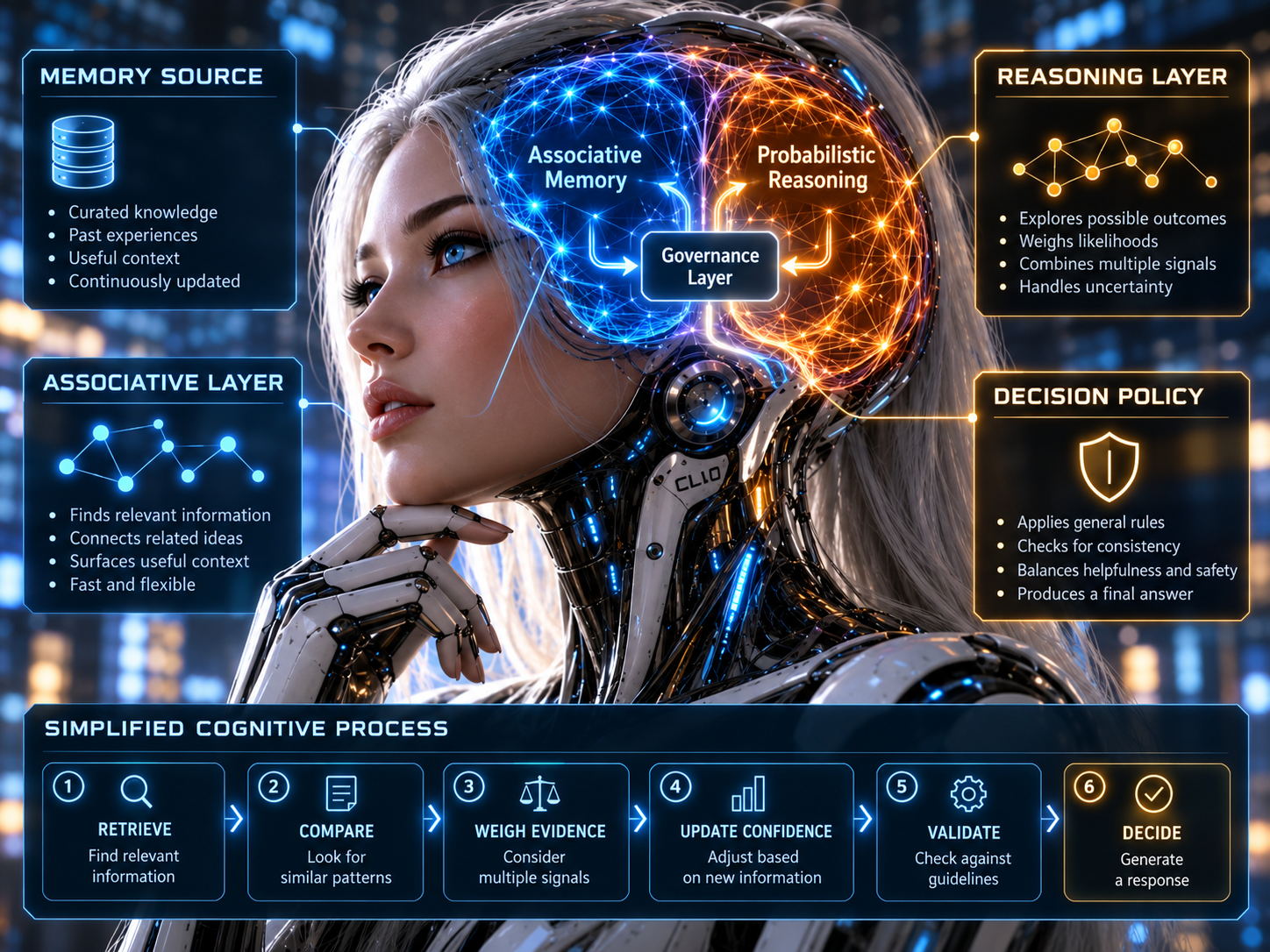
One of the core ideas behind CL1.0 is that intelligence doesn’t come from raw model output alone. It flows through a governed process: Evidence, Memory, Uncertainty, Evaluation, and Authority all working together.
That is where EchoMatch fits.
EchoMatch is subsystem of the EchoWeave memory architecture inside CL1.0.
It helps the system compare a current query, situation, or memory trace against high-dimensional symbolic vectors. These vectors are built using HDC/VSA Hyperdimensional Computing and Vector Symbolic Architecture, where meaning is represented through structured operations through binding, bundling, and sequence shifts.
Its job is to answer a narrower question:
“Which stored candidate traces look structurally similar to this current observation?”
That similarity may come from cosine distance, Hamming-style comparison, or another normalized vector metric. But CL1.0 treats that score carefully. A raw similarity score is not a fact, not memory, not proof. It’s only candidate match evidence.
The CL1.0 pipeline is designed around that separation:
→ calibrated match evidence
→ Bayesian likelihood / posterior input
→ PGM belief update
→ governed belief candidate
→ evidence/provenance review
→ possible action, abstention, or retention decision
This matters because vector systems are powerful but lossy. They can retrieve associations quickly, but they can also accumulate noise, confuse nearby candidates, or create false confidence if similarity is treated as truth.
CL1.0 prevents that by making the PGM/Bayesian layer the meaning and governance layer.
EchoMatch acts like a high-speed memory search instrument, not a judge. It can surface candidates, but the PGM layer decides how much weight those candidates deserve. The system must still check provenance, uncertainty, evidence lineage, calibration, and whether the result should be accepted, rejected, or marked ABSTAIN.
That is the difference between a normal vector database and a governed neuro-symbolic architecture.
EchoMatch gives CL1.0 speed and associative reach.
PGM governance gives it discipline. Together, they allow the system to retrieve like a neural system while preserving the auditability, uncertainty handling, and authority boundaries of a symbolic system.
The goal isn’t to remember more, it’s to remember responsibly.
Leave a Reply