
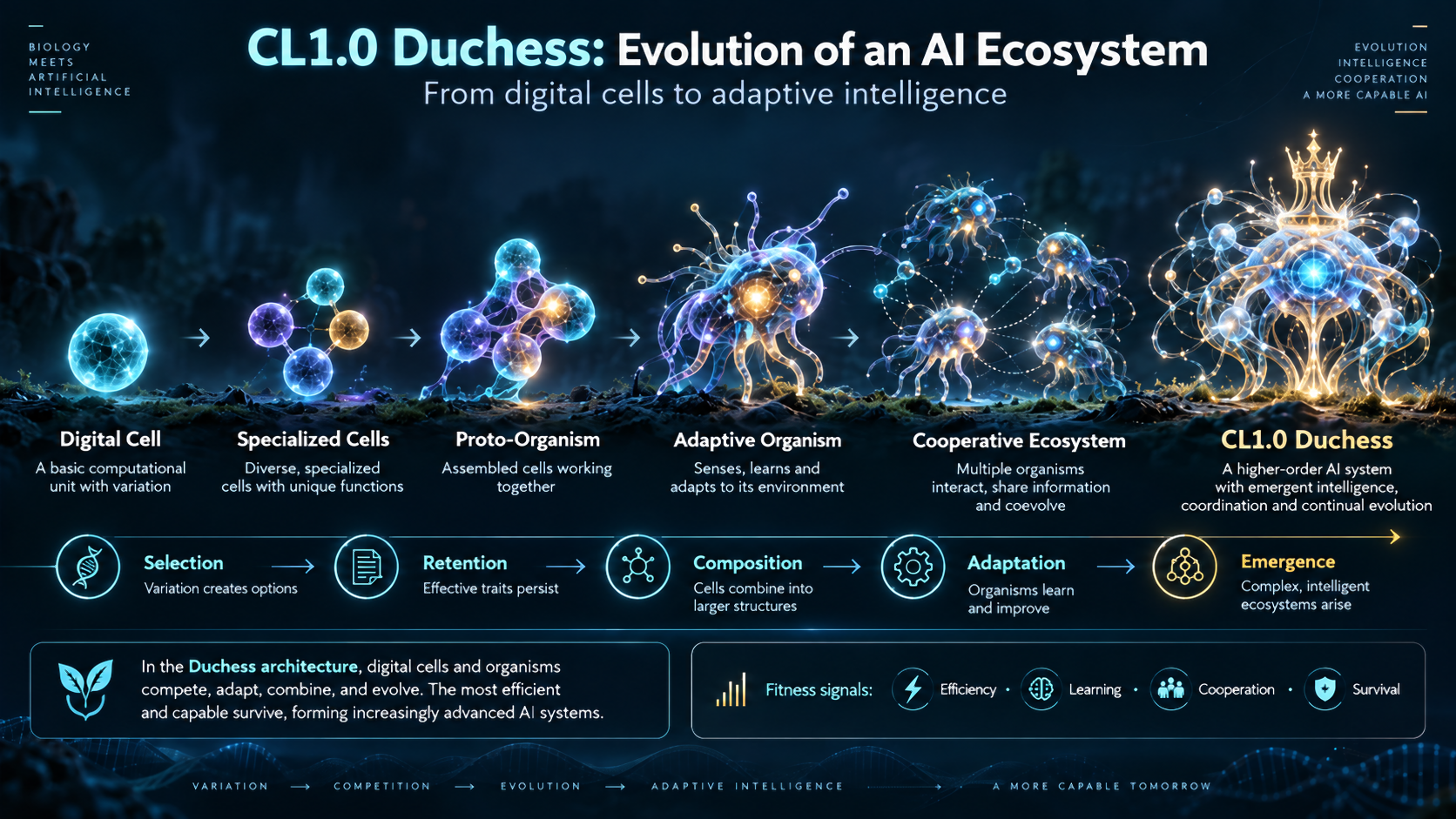
 Nature does not build intelligence from the top down. Evolution creates intelligence through an iterative process of adaption and natural selection.
This is the foundation of our research and development into the CL1.0 Duchess architecture. Instead of creating another monolithic artificial intelligence, we propose an architecture that emulates individual cells and the ecosystems that they form. An artificial ecosystem of digital cells could be constructed, with each cell performing a function, utilizing resources, and adapting to environmental forces.
Genomes are formed from clusters of cells, which could then band together in consortia to perform more diverse and complex functions. Not all cells or organisms will be successful, the resource economy and selection pressures in the ecosystem would favor cells and organisms which were able to maximize their efficiency, adapt to changing conditions, learn from experience, cooperate with each other, and utilize available resources to achieve greater complexity and functionality.
Not every capability which arises will be retained, but the most useful innovations will be incorporated into the system by being made into part of the underlying architecture that supports it. Through successive generations of testing, we will prove if these principles of selection can lead to the emergence of increasingly complex forms of artificial intelligence.
The best form of intelligence will not necessarily arise from any single genome, but through a consortia of genomes which utilize their diversity to cover more capabilities and perform more functions will tend to outperform those which do not.
Evolution in this system, like in nature, will likely not follow a predictable trajectory, where the most fit forms of intelligence will incorporate the most diverse set of capabilities.
Artificial evolution must have parameters and be judged on objective criteria. Fitness of an evolving artificial intelligence be measured by its ability to perform useful work, adapt to new conditions, learn from experience, utilize resources effectively, and provide consistent and desirable results.
The purpose of the CL1.0 Duchess project is to test our theories about artificial life and biological evolution while creating new advancements in the field of artificial intelligence.
We intend to create a self contained and self sufficient system of artificial agents which can provide value to the user by generating new information and insights within environments where a new class of AI can emerge.
The next major innovation in artificial intelligence will not be a more complex algorithm, but an entire ecosystem of simpler algorithms working together in concert.
#ArtificialIntelligence#CL10#DuchessArchitecture#ArtificialLife#EvolutionaryAI#BioInspiredComputing#EmergentIntelligence#AIResearch#ProcessGuidedAI
Leave a Reply