
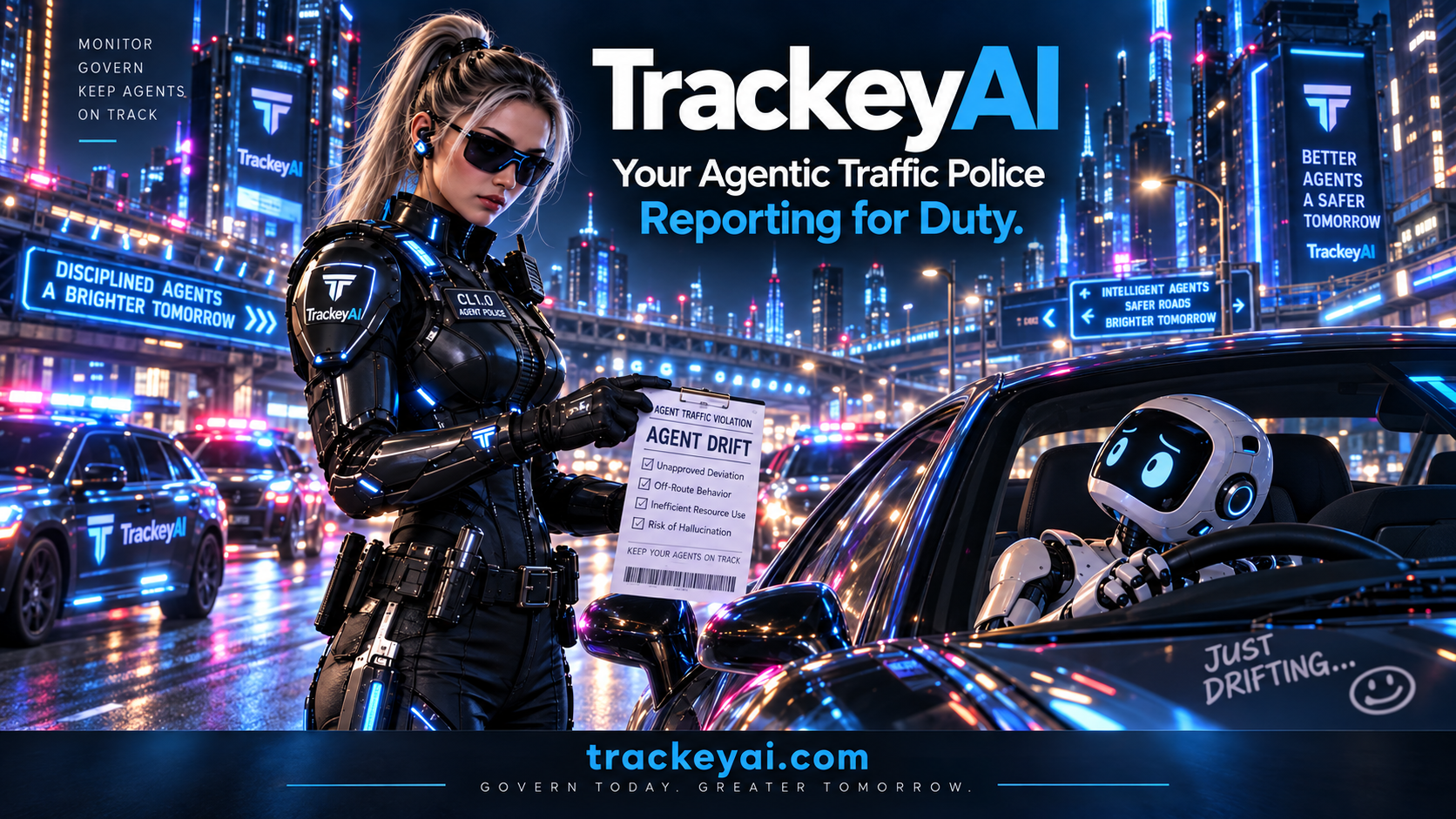
 Use case: Reduce the operating costs of AI, increase accountability, create audit records, prevent AI workflow drift.
1. The Business Problem
Businesses are accelerating the adoption of AI agents to support employees in performing coding, document analysis, and IT ticket resolution, research, project management, and operational activities. However, AI-assisted activities present a management and control challenge.
An employee can instruct an AI agent to perform an operation, while the AI agent autonomously expands the scope, omits validation, repeats unproductive actions, or asserts completion without sufficient supporting evidence.
This creates five potential costs to the business:
• Rework: The employee must invest additional time and effort to repair or repeat the AI-assisted work.
• Wasted Tokens: Additional calls, repetitions, and extended AI execution consume additional compute resources and API tokens.
• Accountability: The manager cannot fully reconstruct who authorized the work, what the AI agent did, and why.
• Compliance: Ad hoc execution can create incomplete records and insufficient audit trails for internal or external review.
• Drift: The AI agent may take actions that fall outside approved requirements, procedures, scope, or acceptance criteria. (2026: 89.2% evaluation pass-rate failure: In industry benchmark testing by AgentStatus)
The fundamental challenge is that granting employees access to AI does not automatically grant employers control over the execution of AI-assisted work.
2. The TrackeyAI Solution
TrackeyAI introduces a local independent governance mechanism for authorized AI-agent execution.
Instead of granting the AI agent autonomous authority to perform work, TrackeyAI creates a governed work package that defines the objective, scope, exclusions, acceptance requirements, and evidence obligations.
The AI agent can perform legitimate work within the governed work package, but consequential checkpoints are evaluated against the approved execution contract.
3. Employer Scenario: Enterprise IT and Cybersecurity
Imagine a 75-employee enterprise that uses AI assistants for software engineering, security remediation, change management, documentation, and infrastructure maintenance.
A cybersecurity analyst provides the following instruction to an AI agent:
“Review the vulnerability findings, determine the required remediation, update the approved configuration, validate the changes, and prepare the completion report.”
Without TrackeyAI
The AI agent may begin the work with an inadequate interpretation of the request, select an unsuitable environment, expand the changes in unauthorized directions, or fail to complete all the validation steps. The AI agent may assert completion even though the change was not fully validated. The employee may have to reconstruct the agent’s work, repeat troubleshooting, review the changes, or explain the outcome to a manager.
The business bears the cost of both the initial AI execution and the required employee rework.
With TrackeyAI
The employee requests an authorized governed run.
The execution contract defines the systems that are under change, the permitted activities, the changes that are not allowed, the tests that must be completed, and the evidence that must be submitted. The AI agent performs the work, submits the required evidence at each checkpoint, and receives governance decisions that determine whether the next action can proceed.
If the AI agent attempts to make an unauthorized system change, the governed action is blocked.
If a validation step was not completed, the execution run cannot complete.
At the conclusion, the employer has an execution summary report that describes the governed activity, the submitted evidence, the decisions, outstanding findings, and overall completion status.
• Business outcome: Reduced rework and manual reconstruction of autonomous agent execution.
4. Complete Employee-Agents Auditability
The enterprise audit objective is to enable authorized management and compliance personnel to reconstruct work performed by employees and their AI agents.
For a fully instrumented deployment, the audit architecture should capture the following information about each work package:
Audit dimension: Information available to an authorized reviewer
Employee attribution: Employee identity, organizational unit, and applicable role
Agent attribution: Agent/provider identity and relevant configuration/version
Work authorization: Approved objective, scope, exclusions, and contract identity
Interaction history: Captured employee instructions, agent responses, and relevant tool events
Execution history: Actions attempted, completed, rejected, or blocked
Contract integrity: Execution contract ID, version, and hash
Validation evidence: Required checks, submitted evidence, and findings
Governance decisions: Approved, Needs Attention, Failure
Resource usage: Captured token consumption, execution duration, and attributable cost
Final disposition: Completion status, unresolved issues, and applicable approvals
Example audit inquiry: A manager asks the following question: “Who authorized this configuration change, what did the AI agent do, and did it pass validation before completion?”
Instead of asking an employee to reconstruct the sequence of events from multiple chat transcripts, the reviewer can examine the correlated run record and execution evidence. The resulting audit trail can establish distinctions between employee authorization, agent observations, governance decisions, and final acceptance.
Implementation distinction
TrackeyAI documentation covers governance reporting, including run status, contract retrieval, requirement check-ins, and execution reports. Capturing every employee prompt, agent response, tool invocation, and resource cost requires additional enterprise telemetry integration.
The optional agent guide does not automatically capture ordinary chats.
An employer should distinguish between run execution audit and complete conversation surveillance. Enterprise audit coverage requires approved integrations, capture policies, access controls, retention requirements, and enforcement across managed AI tools.
5. Drift Prevention: TrackeyAI and RQ-002
One of the greatest risks of autonomous AI is the potential for an agent to slowly depart from the original requirements.
TrackeyAI prevents execution drift by associating work with an immutable execution contract and evaluating progress against authoritative checkpoints.
RQ-002 describes an alternative deterministic workflow-control pattern: The AI agent interprets employee input and contributes evidence, but a determinism authority engine decides whether the workflow can proceed. With RQ-002, workflow progression is based on committed state rather than an AI model’s interpretation of what should happen next.
For example, if a security remediation workflow requires five approved stages, an AI agent cannot legitimately declare that stage three is complete simply because it asserts that validation was successful.
The workflow authority must verify the required evidence and commit the state transition.
If the persistent state fails, the workflow does not advance or create a false completion acknowledgment. In the CL1.0 architecture, RQ-002 is the canonical workflow authority, with protected workflow state in its designated local authority boundary.
TrackeyAI’s execution contract governance is a separate domain; connecting the two would require an explicitly approved integration so that neither could silently override the other’s authority.
These two controls provide an important enterprise design principle.
The AI can recommend and execute authorized work, but the AI does not decide whether governance requirements have been satisfied or whether protected workflow state may change. These two controls reduce procedural and execution drift; they do not ensure that every generated answer is factually correct.
6. Financial Justification: Illustrative Employer ROI
Consider an employer that adopts governed AI execution for 75 employees.
Annual cost model
Assumption Illustrative value
Employees using AI agents: 75
Governed tasks per employee per week: 10
Total governed tasks per week: 750
Baseline task rework rate: 15%
Target task rework rate: 7%
Average hours per avoided rework task: 1 hour
Fully loaded labor rate: $85/hour
Productive working weeks: 48
Reducing the rework rate from 15% to 7% avoids approximately 60 rework events per week or 2,880 hours per year.
Estimated annual financial impact
Benefit category Annual value
Avoided employee rework: $244,800
Reduced manual audit preparation: $36,000
Total modeled operating benefit: $280,800
TrackeyAI deployment and operating cost: $8,991.00
Net illustrative benefit: $271,809
Illustrative ROI: 3,023%
The resulting savings depends on the adoption rate, integration costs, baseline measurable defects, and whether recovered labor hours create productive capacity or reduce cash expenditure.
7. Why an Employer Would Invest
TrackeyAI transforms enterprise AI adoption from individual tools into an organizationally governed execution process.
- For the CFO, it creates tangible opportunities to reduce rework and lower the visibility of AI operating costs.
- For the CIO and CTO, it provides execution controls that reduce the burden of employee prompting discipline.
- For the CISO, it creates checkpoints, evidence requirements, authorization boundaries, and a mechanism to stop governed actions that violate those boundaries.
- For Compliance and Internal Audit, it makes execution records, decisions, evidence, and exceptions more accessible and reconstructable.
- For employees, it clarifies approved boundaries, reducing ambiguity while still permitting agents to complete legitimate tasks.
8. Enterprise Success Measurements
An employer can evaluate a TrackeyAI enterprise deployment using outcome measurements such as the coverage of governed runs, employee rework hours, first-pass acceptance rate, average cost per completed work package, unauthorized action attempts prevented, audit reconstruction time, evidence completeness, and percentage of completed work package that met all required acceptance criteria.
The most compelling business case for an enterprise deployment is to compare these results before and after adoption.
Executive value proposition
TrackeyAI is a local AI execution governance platform that helps employers reduce the operating costs of AI-assisted work while increasing accountability and reducing uncontrolled agent behavior. Conventional AI tools focus on helping employees get work done; TrackeyAI focuses on whether that work was authorized, performed within scope, supported by evidence, and completed according to organizational requirements.
Its value is not in generating more AI output; its value is in reducing the cost and risk of obtaining results that the business can trust.
TrackeyAI: Your morning stand-up takes 15 minutes. Taking back control of your AI agents shouldn’t take longer.
Currently in Beta! TrackeyAI is a local Windows application featuring one-click installation and secure, credential-based authentication.
Now offering full Multi-Agent Cursor MCP support, with OpenAI plugin acceptance pending and full Claude and OpenCode integration support in development.
Trackeyai.com / MorcraneStudios.com
#TrackeyAI #AIGovernance #AIAgents #AgenticAI #AIAccountability #ResponsibleAI #EnterpriseAI #AIAutomation #AIAudit #AICompliance #AIDrift #Cybersecurity #AIWorkforce #ArtificialIntelligence #FutureOfWork
Leave a Reply