
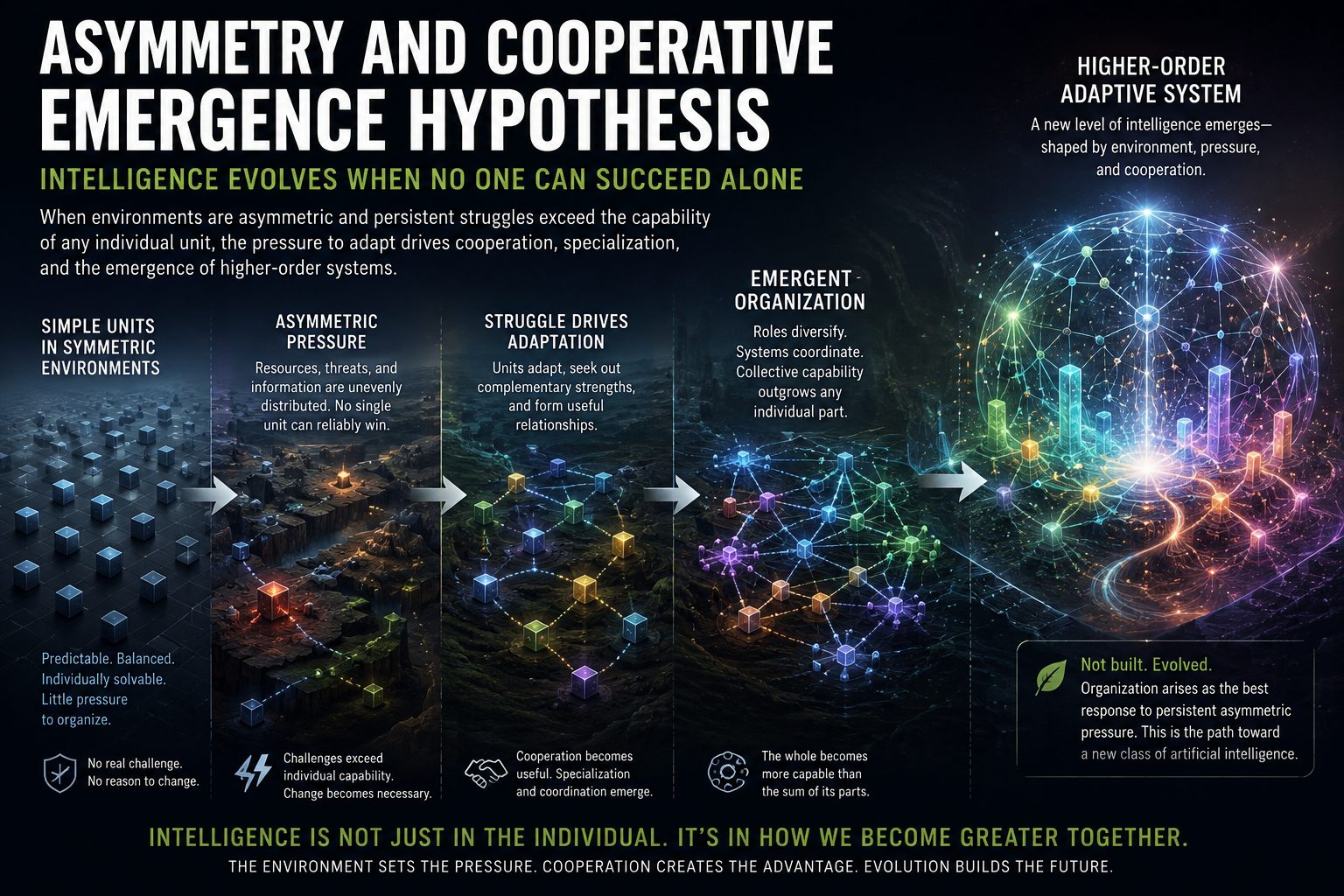
Evolution doesn’t build complexity by simply scaling up a single organism.
It’s driven by pressure: uneven resource distribution, shifting threats, and hard environmental limits that no single creature can handle alone. Over time, those conditions force new strategies to take root specialization, cooperation, and symbiosis.
Major evolutionary leaps follow this pattern. Independent organisms started working together because collaboration unlocked advantages solitary action couldn’t match. Over generations, these ties deepened, turning loose associations into interdependent systems. The outcome wasn’t just a crowd of separate creatures doing similar things side by side; it was a higher order of organization with capabilities no individual part possessed.
We believe artificial intelligence can respond to this same dynamic.
When we train AI models in predictable, uniform environments where every task is solvable by a single unit, there’s no reason for new organizational structures to form. The individual model works fine, so nothing changes. But if we introduce persistent asymmetry, unequally distributed information, tools, constraints, and workloads no single unit can consistently solve problems in isolation.
Struggle isn’t added here just to make training difficult; it acts as a selective force. An artificial unit facing an insurmountable problem has a few choices: fail, adapt its behavior, leverage a complementary unit, or join a larger functional structure. When these conditions persist across training iterations, cooperation and the division of labor become practical necessities rather than pre-programmed logic.
Current multi-agent research relies heavily on human defined architectures. Engineers predefine roles, communication protocols, and hierarchies, then run models inside those rigid boundaries. We are asking a different question: What happens when the environment forces the need for organization, but we leave the actual structure unscripted?
Given enough asymmetric pressure, artificial units should form stable patterns of specialization, reliance, and collective problem-solving naturally. The system still operates within safety boundaries, but its internal structure emerges through developmental pressure rather than manual blueprinting.
Systems trained this way will likely diverge significantly from standard single model optimization or rigid agent workflows. We expect to see authentic functional specialization, mutual reliance, higher resilience, and coordinated behavior that can’t be reduced to the actions of any single component.
If this holds true, it points toward a fundamentally different model for AI. Instead of trying to squeeze intelligence into one massive, monolithic model, capability can emerge through network relationships between smaller, focused units. The breakthrough isn’t just what an individual unit knows, but how the collective self-organizes when pushed.
This starts to look less like a standard software pipeline and more like an artificial organism a system whose strength comes from adaptation, specialization, and collective coordination under pressure. The next major shift in AI may come from building environments where individual models are forced to fail alone, driving them to adapt, specialize, and organize together.
Leave a Reply