
AI Process Language Alphabet, Dictionary, Translation Rules, and Introductory
CELL Lab Research Draft
Christopher Sheckler
August 21, 2026
Research status: PROPOSED FOUNDATIONAL SPECIFICATION
Abstract
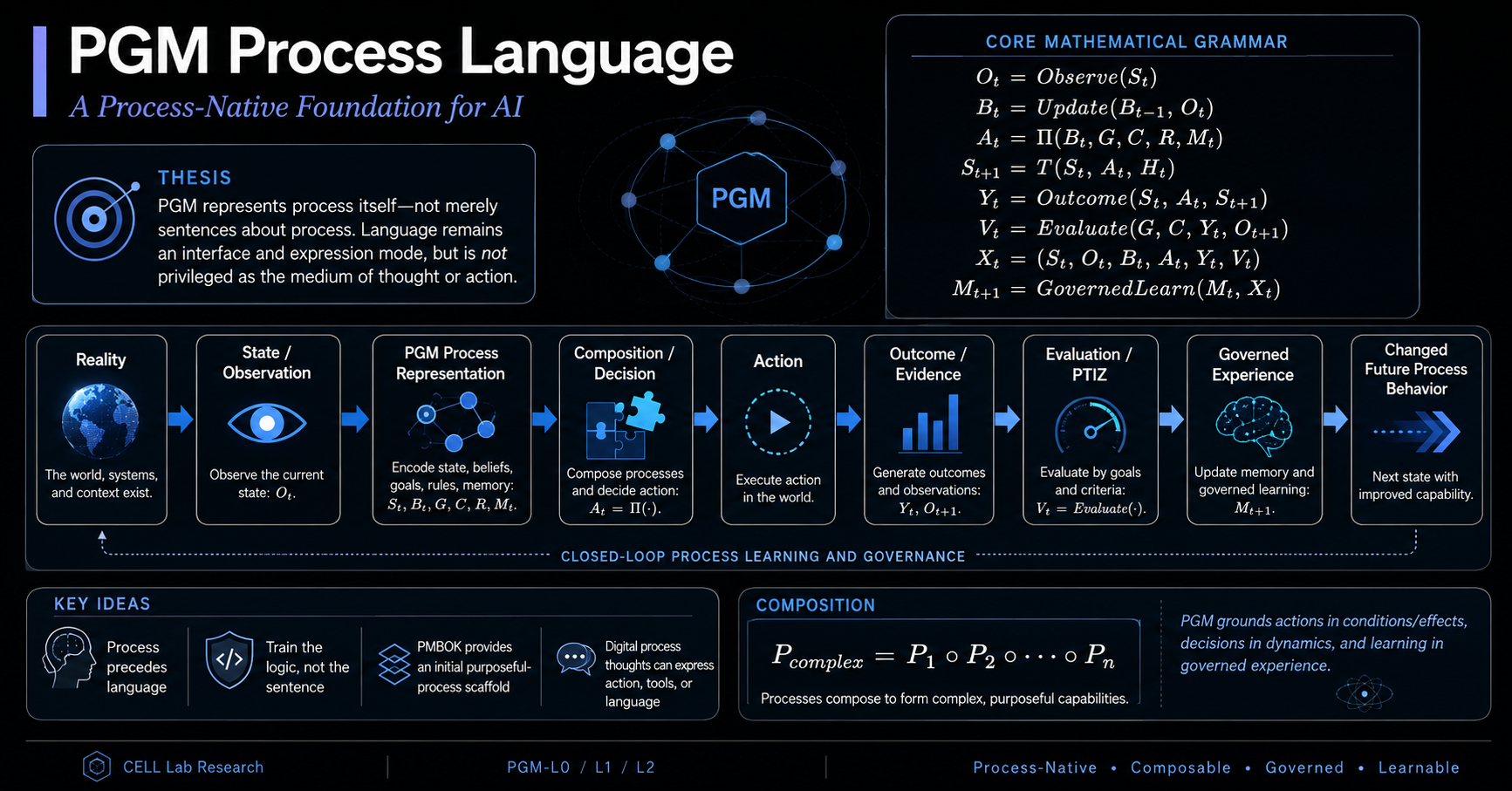
PGM (Process-Guided Model) posits a process-native foundation for AI in which internal representation takes the form of process, state, interaction, constraint, transition, consequence, evidence, and learning rather than natural-language tokens. The latter remain available as an interface and expression mode, but are not privileged as the medium of thought or action.
The foundational design proposition of PGM is that it
| represents process itself,and not merely sentences about process. |
Its alphabet is therefore not predominantly letters or words, but rather state, observation, transition, goal, constraint, action, consequence, evidence, experience, composition, and related operators.
This document presents the first proposed PGM alphabet and dictionary, explains how a PGM representation can be compiled from and translated back into natural language, and provides a candidate set of first lessons and examples in this emerging language for CELL training. The work draws on multiple existing formalisms for describing process, including temporal logic, state-transition models, planning and control theory, Markov decision processes, Communicating Sequential Processes (CSP), provenance specification, and behavior composition, among others. These are presented as conceptual foundations rather than as notational precursors – PGM aims to adopt the mathematical semantics of these areas while remaining process-native in its representation language.
Research grounding
Across multiple fields, process can be represented in mathematical notation that does not privilege natural-language constructs as the core medium of expression:
TLA+ specifies software correctness using states and next-state relations.
PDDL/PDDL+ encodes planning domains and problems in terms of actions, preconditions, and effects.
Control theory describes systems in terms of state, inputs, and response.
MDPs and POMDPs encode decision processes as states, actions, transitions, and observations.
CSP provides mathematical operators for describing concurrency.
W3C PROV defines proof traces in terms of activities, entities, agents, usage, and generation.
PMI’s PMBOK processes define a human-level process-group discipline with potential value for encoding purposeful process.
The design objective for PGM is to encode process-native behavior using the mathematical foundations from these areas while retaining a notation that privileges process execution, composition, consequence, evidence, and developmental learning as foundational concepts.
PGM Process Language Foundational Design v0.1 will be release upon patent completion.
Leave a Reply