
We are proud to report that CLIO has moved beyond a concept and into a working research system.
- We’ve defined and frozen a process-based language for representing state, actions, outcomes, evidence, and learning.
- We’ve begun validating these ideas through controlled CELL experiments, focusing on measurable behavior rather than conversational claims.
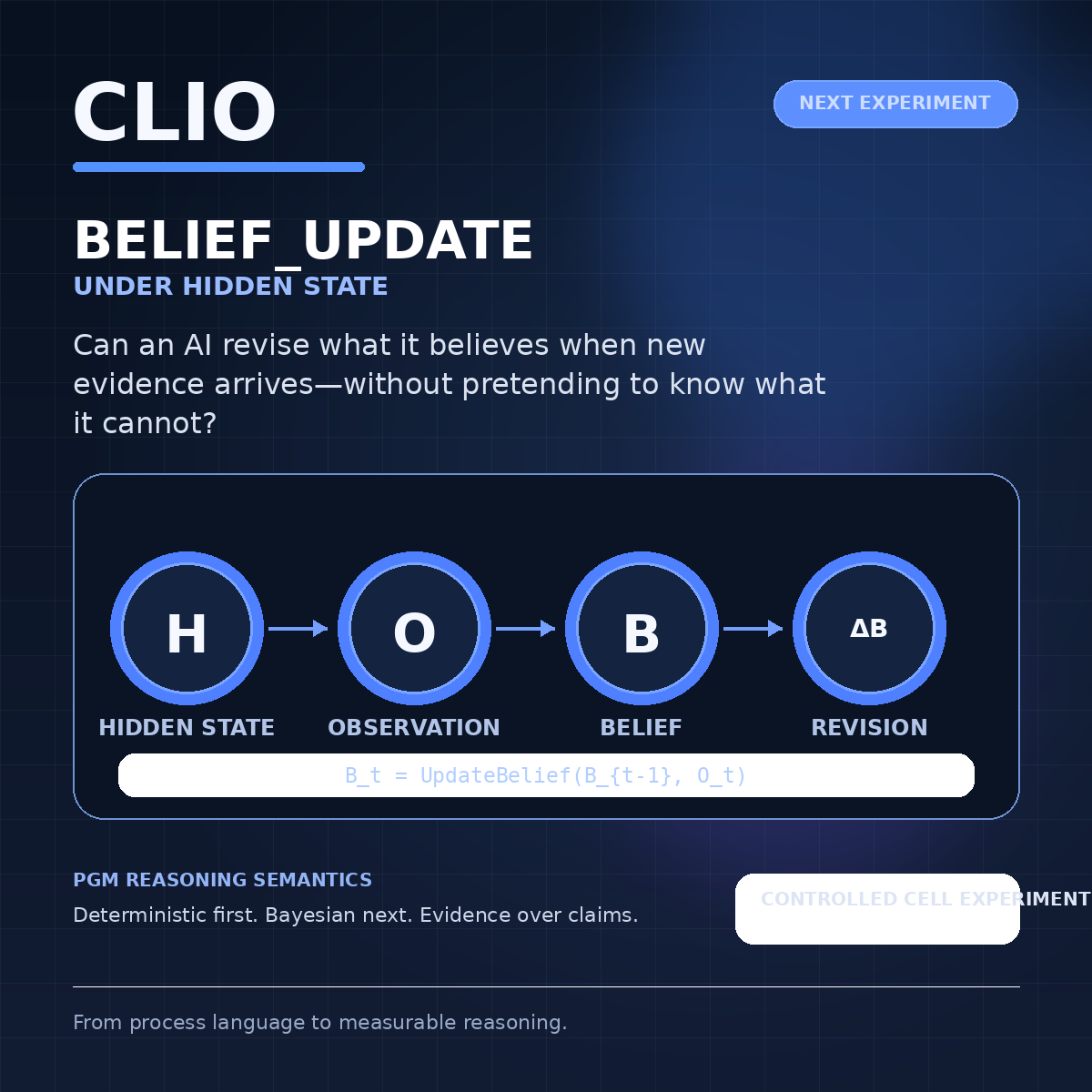
- Our next experiment asks a simple but important question: Can CLIO hold a belief about something it cannot directly observe, revise that belief when new evidence appears, and preserve uncertainty when the evidence is not strong enough?
- We’ll first test this under deterministic conditions, then evaluate Bayesian probability as a candidate mechanism for reasoning under uncertainty.
- Step by step, we’re working toward an AI that can do more than generate convincing language one that can form beliefs from evidence, revise them, reason under uncertainty, learn from consequences, and transfer what it learns to new situations.
- The long-term goal is to achieve this through an auditable process architecture, where we can trace how CLIO reached a conclusion, what evidence influenced it, and how experience changed its future behavior.
Leave a Reply